Keratin Treatments in Palm Harbor: What They Really Cost, How Long They Last, and the Honest Truth About Humidity & Formaldehyde
A Palm Harbor master stylist's straight-talk guide to keratin — real prices, real timelines, and how to survive a Florida summer with smooth hair.
You already know the feeling. You walk out of the shower, your hair looks incredible for about ninety seconds, and then the Gulf air gets to it. By the time you're in the car it's lifting at the crown. By the time you're at work it's a halo. In Palm Harbor, frizz isn't a bad-hair-day problem — it's a nine-months-of-the-year problem, and no amount of product spray is going to out-muscle a 73-degree dew point.
That's the reason keratin treatments have a cult following down here. Done right, a keratin treatment is the closest thing the hair world has to a cheat code for humidity. Done wrong — or bought on price alone — it's a few hundred dollars of disappointment and a faint chemical smell you can't place.
So here's the honest version. Not the brand-brochure version, not the fear-mongering version. The straight talk you'd get from Manny Sena, the master stylist behind Vibe Salon's one-chair studio, if you sat down in his chair and asked him the questions everyone's actually thinking: What does this really cost? How long will it actually last? Is the formaldehyde thing real? And will it survive a Tampa Bay August?
Let's get into it.
What a keratin treatment actually is (in plain English)
Strip away the marketing and a keratin treatment is simple to understand. Your hair is built mostly from a protein called keratin, held in shape by tiny internal bonds. Humidity is frizz's best friend because water molecules sneak into the hair shaft and break some of those bonds temporarily — the hair swells, the cuticle lifts, and smooth turns to fuzzy.
A keratin smoothing treatment works by coating and partially sealing the hair shaft with a keratin-based solution, then locking it in with the heat of a flat iron. The result isn't a chemical "straightener" that melts your curl pattern away forever. It's a smoothing layer that lays the cuticle down flat, blocks a lot of that water intrusion, and makes your hair behave — less frizz, more shine, and a blow-dry that takes half the time.
That's the real magic for a Florida client. It's not about making your hair dead-straight. It's about making it humidity-proof enough that your style survives the walk from the parking lot.
There's craft in it, though. The strength of the solution, how it's sectioned, the iron temperature, how many passes — that's where a master stylist earns the difference between "smooth and natural" and "flat and greasy-looking." It is, in Manny's words, a work of art carefully applied to the person in the chair, not a one-size protocol poured out of a bottle.
What it really costs in Palm Harbor in 2026 (the honest tiers)
Here's where most articles get vague and every salon site gets cagey. Let's not.
Across the Tampa Bay area, a professional keratin treatment generally runs somewhere between $150 and $400+, and the spread isn't random. Price tracks three honest things: how much hair you have, how strong a treatment it needs, and how skilled the hands doing it are.
A rough, honest map of what you can expect:
| Hair length & density | Typical investment | What you're paying for |
|---|---|---|
| Short / fine | $150–$200 | Less product, faster application |
| Medium / shoulder-length | $200–$300 | The most common tier in Palm Harbor |
| Long / thick / coarse | $300–$400+ | More solution, more sectioning, more iron time |
| Add-on at a color appointment | +$100–$175 | Bundled onto a balayage or color day |
Now the part nobody tells you: what the bottom-dollar version actually is. When you see a keratin treatment advertised for $79 or $99, one of a few things is usually true. It's a watered-down solution, it's a "express" treatment that washes out in three weeks, it's being done by the newest person on the floor, or the real money comes from upselling you in the chair. There's nothing wrong with an express treatment if that's genuinely what you want — but paying express money expecting four months of results is how people decide "keratin doesn't work for me." It worked fine. You just bought thirty days of it.
The honest way to think about cost is per-month-of-results. A $280 treatment that lasts four months is about $70 a month of smooth, fast, frizz-free hair. A $99 treatment that lasts three weeks is about $130 a month. The premium option is frequently the better value — which is the opposite of what the price tag tells you.
Want a real number for your hair instead of a range? Book a free consult and you'll get a straight quote before anything starts.
How long it actually lasts (and what quietly shortens it)
A quality keratin treatment, properly maintained, lasts three to five months. That's the honest window. Anyone promising six-plus months out of a single treatment is either selling you a stronger (often formaldehyde-based) formula or is rounding up.
What shortens it, faster than people expect:
- Sulfate shampoo. This is the big one. Sulfates strip the treatment out. Switch to a sulfate-free shampoo the day you book, not the day it starts fading.
- Salt and chlorine. Gulf swims and pool days are rough on keratin. Rinse and condition right after.
- Hard washing habits. Every wash is a little erosion. Stretching from daily to every-other-day washing can add weeks.
- Harsh "clarifying" products. They do exactly what you don't want — clarify the treatment right off.
Here's the reframe: a keratin treatment isn't a one-time purchase, it's an investment you protect. The clients who get five honest months out of it are the ones who treat the aftercare as part of the deal. The ones who go back to their old drugstore sulfate shampoo are the ones back in the chair by month two.
The honest formaldehyde answer (this is the part that matters)
This is the section every Florida client deserves and almost nobody writes honestly. So read this part twice.
"Formaldehyde-free" does not always mean "formaldehyde-releasing-free." That's the whole game, and it's where the marketing gets slippery.
Here's the truth. Many traditional keratin treatments contain formaldehyde, or contain ingredients that release formaldehyde gas when they hit the heat of a flat iron. The two you'll see most:
- Methylene glycol — this is formaldehyde dissolved in water. A label can technically say "no formaldehyde" while containing methylene glycol that becomes formaldehyde gas the moment it's heated.
- Glyoxylic acid (and similar aldehydes) — genuinely formaldehyde-free, which is good, but it's gentler/less durable and, because it's acidic, it can stress already-fragile hair if it's overused.
Why care? Because the real risk with formaldehyde-based smoothing isn't your hair — it's the air you and your stylist breathe during application. When the iron hits the solution, formaldehyde can be released as a gas. That's an inhalation issue, which is exactly why OSHA issued a hazard alert on formaldehyde in hair-smoothing products and the FDA has moved to restrict formaldehyde and formaldehyde-releasing chemicals in these products. (Check the current status before you book anywhere — this is an area that's actively changing.)
So what should you actually do with this? Not panic — get specific. Ask three questions before any keratin appointment, anywhere:
- Is this formula formaldehyde-free AND formaldehyde-releasing-free?
- What's the active smoothing ingredient?
- How's the room ventilated during application?
A stylist who knows the answers cold is a stylist who respects the chemistry. At Vibe, that conversation happens before you commit — because the honest version of this service starts with you knowing exactly what's going on your head. That's not fear-mongering. That's the difference between a professional and a price.
The Florida humidity section: why your hair frizzes here specifically
Now the part that actually explains why Palm Harbor is different from wherever you moved here from.
Hairstylists in Phoenix and stylists in Tampa Bay are not solving the same problem. Frizz isn't really about temperature — it's about dew point, the temperature at which the air is fully saturated with moisture. The higher the dew point, the more water is hanging in the air, ready to invade your hair shaft. Anything above about 65°F starts to feel sticky. Above 70°F is the "I changed my shirt twice" zone.
Tampa Bay lives in that zone for half the year. Here's the honest climate picture for the area:
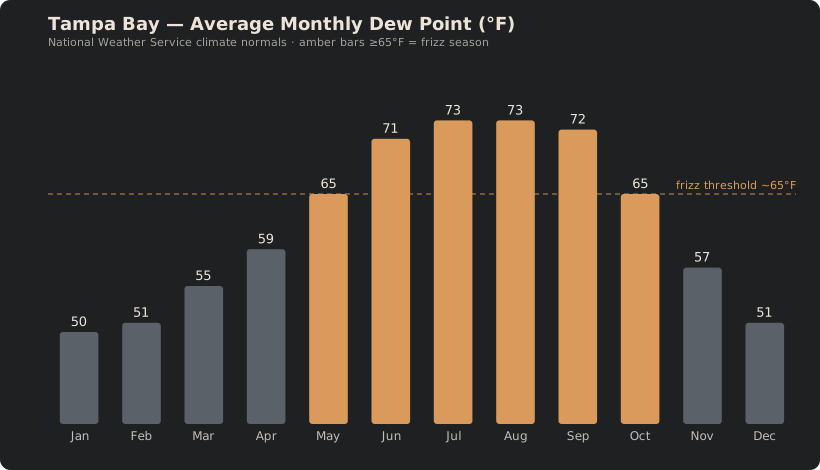
| Month | Avg. dew point (°F) | What your hair feels |
|---|---|---|
| January | ~50 | Calm — your best hair days |
| February | ~51 | Still easy |
| March | ~55 | Starting to lift |
| April | ~59 | Noticeable on humid mornings |
| May | ~65 | Frizz season begins |
| June | ~71 | Full Florida — daily fight |
| July | ~73 | Peak misery |
| August | ~73 | Peak misery |
| September | ~72 | Still brutal |
| October | ~65 | Finally easing |
| November | ~57 | Relief |
| December | ~51 | Calm again |
Approximate monthly average dew points for the Tampa Bay area, based on National Weather Service climate normals. Frizz risk climbs sharply once the dew point clears ~65°F — roughly May through October here.
Read that table as a calendar for your hair. From May through October, the air around Palm Harbor is doing everything it can to undo your blow-dry. That's not a product problem you can spray away — it's a moisture problem, and a keratin treatment is one of the few things that actually addresses it at the source by sealing the shaft so less of that water gets in.
This is also why timing matters. A keratin treatment booked in late spring covers you through the worst of the summer — and since it lasts three to five months, one well-timed appointment in May or June can carry your hair through to fall.
Keratin vs. Brazilian Blowout vs. hair botox: which one is yours?
People use these names like they're the same thing. They're not. Quick, honest decision matrix:
| Keratin treatment | Brazilian Blowout | "Hair botox" | |
|---|---|---|---|
| What it does | Smooths + seals, cuts frizz | Smooths, often stronger/straighter | Deep-conditions + fills damage |
| Best for | Frizz + humidity (most FL clients) | Maximum straightening | Damaged, brittle hair |
| Formaldehyde? | Varies — ask | Often formaldehyde-based | Usually formaldehyde-free |
| Lasts | 3–5 months | 2–4 months | 6–10 weeks |
| Keeps your curl? | Mostly yes (softened) | Less so | Yes |
The short version: if your enemy is Florida frizz and you want to keep your natural texture but tame it, a keratin smoothing treatment is usually the answer. If your hair is damaged and breaking more than it's frizzy, "hair botox" (a conditioning treatment, not actual botox) might serve you better. The right call depends on your actual hair — which is the entire point of a consult instead of a guess.
Is this right for your hair? An honest diagnostic
Keratin isn't for everyone, and a stylist who tells you it is should worry you. Quick gut-check:
- Fine, frizzy hair: Great candidate — but it needs a lighter hand, or it goes limp. Skill matters here more than anywhere.
- Thick, coarse, curly hair: The classic win. This is the hair that benefits most from humidity-proofing.
- Color-treated hair: Usually fine, and often better after — but timing with your color appointment matters. (Manny frequently pairs it with a balayage or color service.)
- Badly damaged / breaking hair: Pump the brakes. You may need a few conditioning treatments first. Honesty here protects your hair and your money.
If you're not sure which bucket you're in, that's not a problem — that's literally what the consultation is for.
Aftercare that actually protects the investment
You paid for three-to-five months. Here's how you actually get them:
- Sulfate-free shampoo, always. Non-negotiable. This single switch is the biggest factor in how long your treatment lasts.
- Wash less. Every-other-day or less. Dry shampoo is your friend.
- Rinse after the beach or pool. Salt and chlorine are keratin's enemies.
- Cool it on the hot tools. You need them far less now anyway — that's part of the payoff.
- Book your refresh before it's gone, not after. Maintaining is easier than rebuilding.
None of this is complicated. It's just the difference between people who say keratin "lasted forever" and people who say it "barely lasted." Same treatment. Different aftercare.
Quick answers (the questions everyone asks)
Will a keratin treatment make my hair dead straight? No — and that's a good thing. A keratin smoothing treatment relaxes frizz and loosens your texture while keeping your natural movement. If you want poker-straight, that's a different and stronger conversation. Most Palm Harbor clients want "smooth and easy to manage," not "flat."
How soon can I wash my hair afterward? It depends on the formula. Some let you wash the same day; more traditional formulas want you to wait a couple of days. Manny tells you the exact window for your specific treatment before you leave the chair — guessing here is how people accidentally rinse a fresh treatment straight back out.
Is keratin safe for color-treated hair? Usually yes, and it often leaves your color looking glossier. The key is sequencing it correctly with your color appointment — which is exactly why pairing the two with one stylist who plans the whole thing beats booking them blind at two different places.
See the difference — and book your spot
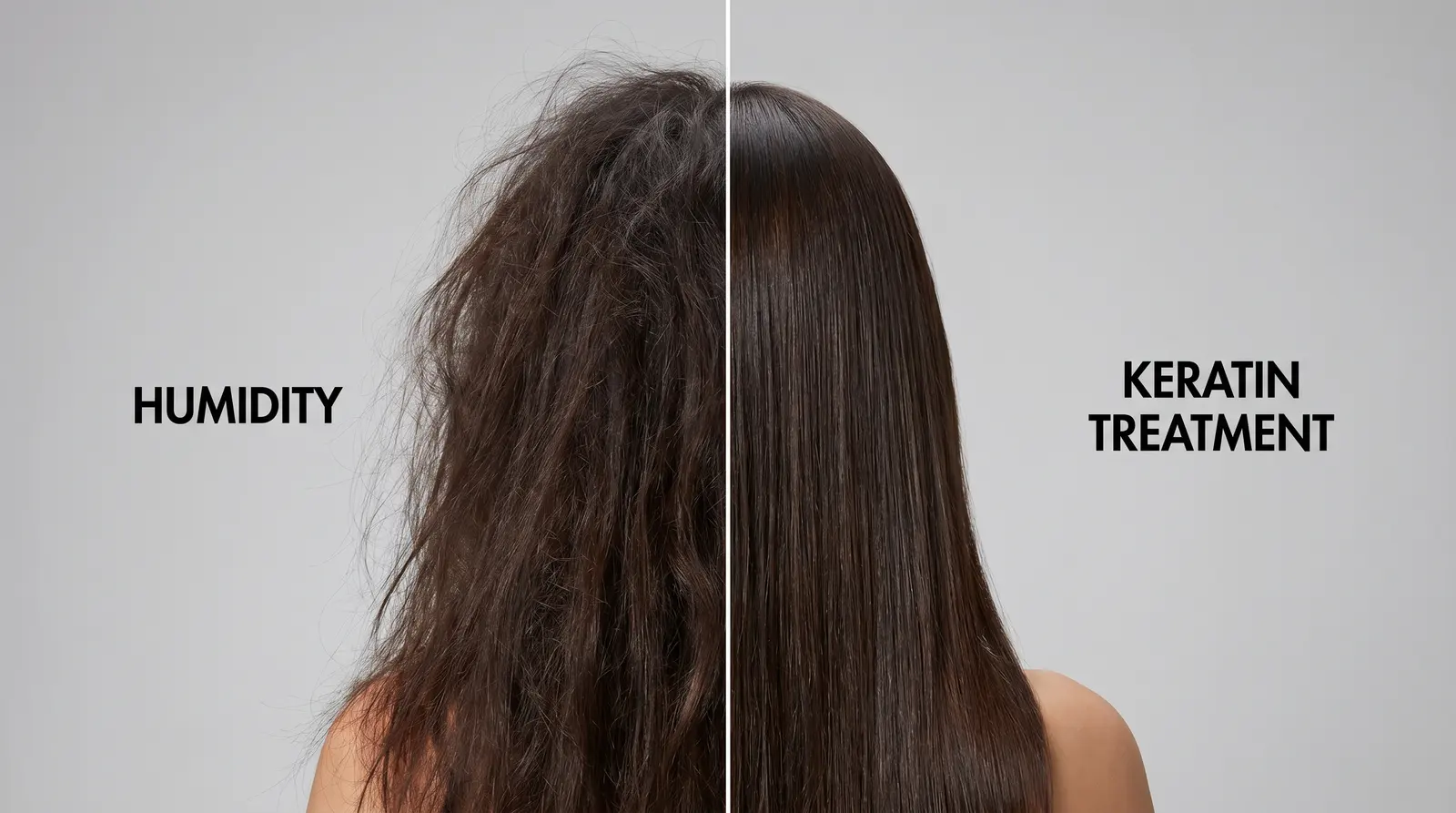
Smooth, shiny, humidity-proof hair that takes half the time to style and survives a Florida summer — that's the whole promise of a keratin treatment done by someone who actually knows the chemistry and the craft. Not a template. Not a price-tag gamble. A treatment built around your hair, in an intimate one-chair studio where you get a master stylist's full attention from start to finish.
That's how Manny Sena works at Vibe Salon in Palm Harbor — NYC-trained, rock-and-roll to the core, and honest with you before you ever commit. If you're tired of fighting the Gulf air every single morning, this is the fix.
Book a keratin consult at Vibe Salon → — get a straight quote and an honest answer about whether keratin is right for your hair. Still deciding? Read the companion guide on beating frizzy hair in Florida humidity or explore all of Vibe's services.
Written from the chair by the team at Vibe Salon, Palm Harbor's one-chair boutique studio. Living life on the edge with supreme style.